
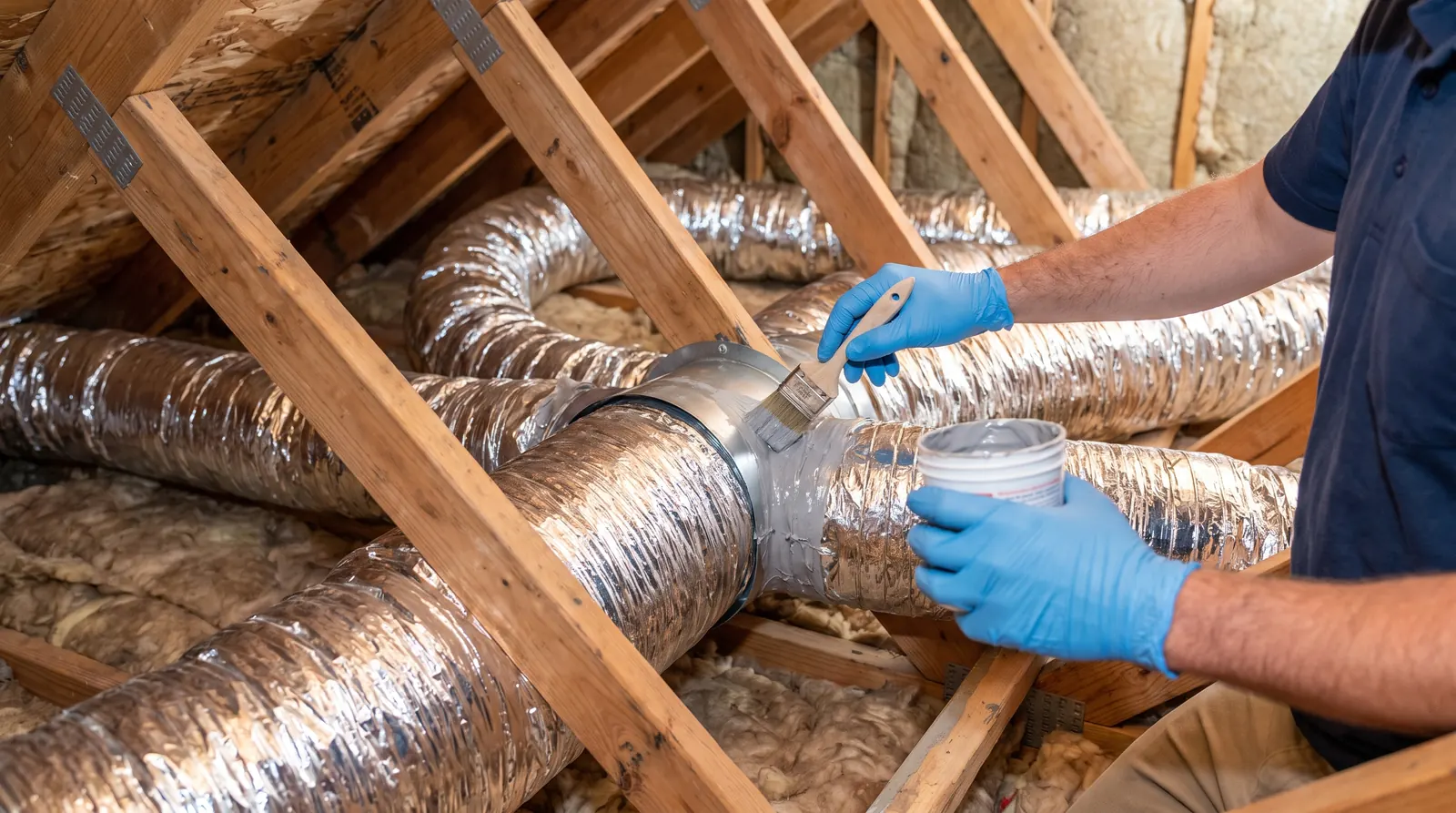
Duct leakage is often discussed as a simple explanation for comfort concerns. Here is a more useful way for Phoenix Valley homeowners to think about ducts, symptoms, and inspection.
Duct leakage is often mentioned whenever a room feels warmer, airflow seems weak, or dust appears near a register. It may be part of the conversation, but it should not become an automatic explanation for every comfort concern. Duct systems are hidden behind ceilings, walls, or attic insulation, and the conditions that affect a room can overlap. A careful approach begins with what you can observe and then moves toward an appropriate inspection.
What ducts do in the home
Supply ducts carry conditioned air from HVAC equipment to rooms. Return paths bring air back toward the equipment. Connections, joints, boots, insulation, routing, and support can all influence how a duct system should be evaluated. In many Phoenix Valley homes, portions of the system are located in the attic, where access and surrounding conditions can make visual review more complicated.
A duct concern may involve an accessible connection, a damaged section, an insulated run, a register boot, or a return-air pathway. It may also be related to something outside the duct itself, such as a blocked grille, a room layout, a closed interior door, attic conditions, or HVAC equipment operation. That is why a room-level complaint benefits from whole-home context.
Start with observations, not assumptions
Write down what you are experiencing. Is the issue limited to one room or an entire floor? Does it happen at a consistent time of day? Is airflow different at one register than at nearby registers? Are there unusual sounds when the system starts or stops? Have you noticed recent work in the attic, on the roof, or around ceiling fixtures?
Look for simple, noninvasive items indoors. Keep supply and return grilles unobstructed, make sure registers are not covered, and note whether doors are commonly closed. Do not rely on tape, sealants, or improvised repairs inside hidden areas unless a qualified professional has identified the specific condition and recommends a method. Accessing attic ductwork without proper footing and heat precautions can create avoidable risks.
What a professional review may consider
An appropriately qualified professional may visually inspect accessible duct runs and connections, evaluate the condition of duct insulation, and look for sections that appear disconnected, crushed, unsupported, or disturbed. Depending on the scope, they may recommend additional HVAC-focused diagnostics. The right method depends on the home, the accessibility of the ducts, and the question being investigated.
Ask the professional to distinguish between visible findings and possibilities that have not been confirmed. If a recommendation involves duct work, ask which areas are involved, how access will be handled, whether adjacent insulation may be affected, and what follow-up is appropriate. This keeps the conversation grounded in the actual condition rather than a general theory.
Keep the goal practical
The goal is not to blame ducts for every comfort issue. It is to understand whether they are one relevant part of a larger system. A hot room can involve solar exposure, the ceiling boundary, attic conditions, supply and return paths, equipment operation, or everyday use of the space.
A useful next step is a documented assessment that connects your observations to accessible evidence. From there, you can decide whether duct-related work, insulation review, HVAC service, or another form of follow-up deserves priority.